
Latvian Robotics Championship · Competition rules 2026/2027
iRobot Sumo rules
1Description
The goal of the competition for the robot is to push the opponent out of the Dohyo (ring area) fully autonomously.
2Competition rules
- 2.1Each robot can be registered with one operator and several assistants. Only the operator is allowed to control the robot. All participants must adhere to the competition regulations and the rules for determining the winner of a match.
- 2.2For safety reasons, referees and participants are required to wear gloves, and a protective cover must be placed on the robot's blade.
- 2.3The competition procedure is determined by the organizers, taking the number of participants into account. If there are many participants, subgroups are used to determine the participants of the final tournament. The final tournaments are conducted using a double-elimination system. If the number of participants is small, they automatically proceed straight to the final tournament under its rules.
- 2.4The competition organizers decide which of the following methods will be used to start and stop the robots' movement:
- Infrared remote control operated by the competition referee
(See Appendix 2) - 5-second delayed start and manual stopping
(Using a button or remote control operated by the robot operator)
- Infrared remote control operated by the competition referee
- 2.5During the competition (during a round), remote controls must be placed in a predetermined location. Remote controls may be used only to stop the robot, and only when the referee gives the appropriate command. The official infrared remote control is held by the referee.
3Robot
- 3.1The robot must be fully autonomous. Its movements must be designed so that the robot detects the opponent's robot and can respond accordingly. If there is any doubt about whether the robot is autonomous, the referees have the right to inspect the robot's control logic.
- 3.2The robot's maximum size and weight:
Length (cm) Width (cm) Height (cm) Weight (g) Original outer shape Unlimited 4200 Table 1. Maximum parameters of an iRobot Sumo robot - 3.3The robot may increase in size after the start, but it must remain in one piece.
- 3.4If necessary, the infrared sensor must be placed on the top of the robot. It must not be placed on the sides or underneath. The robot operator must ensure stable and uninterrupted operation of the receiver, as far as possible in all possible conditions.
- 3.5Robots must be marked with identification number stickers. It is the robot operator's responsibility to provide space for them. The stickers are supplied by the competition organizers. If necessary, the same number plates will be attached not only to the robots but also to the participants' clothing.
- 3.6It is forbidden to use any components that may detach from the robot during its movement or upon contact with another robot. Double blades are not prohibited.
- 3.7The following are prohibited in the robot:
- Any components that could interfere with the operation of the opponent's robot.
(For example, special sources of electromagnetic waves or jamming devices, such as infrared LEDs intended to interfere with the operation of the opponent's infrared sensors). - Any components that may damage or scratch the surface of the Dohyo ring.
The only exception to surface damage is collisions between robots. - Any liquids, powders and gases as weapons against the opponent.
- Any easily flammable materials in the robot's construction.
- Throwing devices, such as a net thrown at the opponent's robot.
- Parts that attach to the surface of the Dohyo ring. (Glues, suction cups, etc).
- Magnets.
- Any components that could interfere with the operation of the opponent's robot.
- 3.8Additional requirements for the iRobot Sumo class
- The following robots are allowed to take part in the iRobot Sumo class:
- iRobot Roomba®
- iRobot Scooba®
- iRobot Create®
- The robot's original wheels are the only drive element that may touch the surface of the Dohyo ring. The original robot wheels may be controlled only by the original power source, motor controllers and power supply unit.
- The following modifications are allowed
After the modifications, the robot must still be recognizable as the original robot model.- Parts of the robot intended for cleaning may be removed.
- Computing elements and electronic devices may be added.
- Electromechanical components may be added.
- As an exception to the general rules, an external computer and an autonomous remote-control algorithm may be used in the iRobot Sumo class.
- The following robots are allowed to take part in the iRobot Sumo class:
4Field a.k.a. Dohyo Jyonai
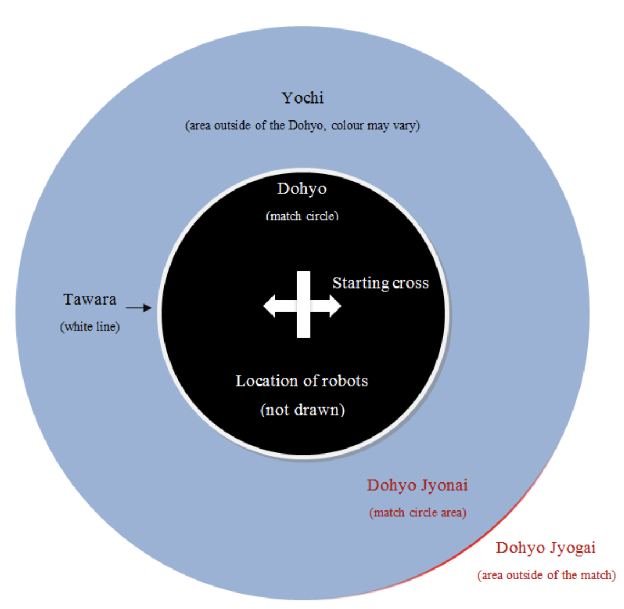
- 4.1Dohyo Jyonai (competition area) consists of the Dohyo (ring area) and the Yochi (outer edge of the ring area). The rest of the area is considered Dohyo Jyogai (the area outside the ring). Protective barriers surround the Dohyo Jyogai ring.
- 4.2Dohyo (ring area) is a circular area covered with a black coating.
Height (cm) Diameter (cm) Surface material 5 154 Plastic or wood or metal Table 2. iRobot Sumo field parameters - 4.3Starting cross
The starting cross is placed in the centre of the Sumo ring area, dividing it into four equal sectors. Robots must always be placed in two diagonally opposite sectors (see Figure 1). Each robot must cover the Tawara (white line) at least partially. The referee removes the starting cross from the area once the robots are placed on the area. Once the robots are placed, they must not be moved any more.
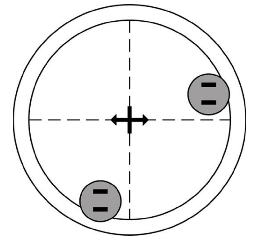
Figure 1. Starting cross If the Sumo ring area is made with Shikiri-Sen (starting lines) instead of a starting cross, the same rules apply as shown in Figure 2. No part of a robot may go beyond the sector bounded by the Shikiri-Sen (starting lines). The participant's robot must cover the Tawara (white line) at least partially. The competition organizers will announce additional information on which type of Sumo ring will be used at the particular competition.
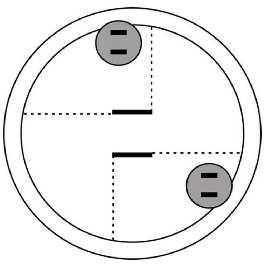
Figure 2. Sumo ring area with Shikiri-Sen starting lines - 4.4Tawara is the white line along the outer edge of the Dohyo ring. The Tawara line is part of the Dohyo ring. Its width is 5 cm.
- 4.5Yochi is the area around the Dohyo, at least 250 cm in diameter. The colour and material of the Yochi may vary, but it must not be white.
5Competition procedure
Terminology: A match consists of rounds. One round is one fight.
- 5.1Match principles
- A match usually takes place in three rounds and lasts up to 3 minutes. The team that first scores 2 Yuko points (awarded points) during the match wins. Match time is measured during the rounds, not between them.
- If only one Yuko point is scored by the end of the match, the team that scored that point wins.
- If no team wins a round during the match time, the winner will be announced according to the situation by Yusei (advantage). If Yusei cannot be determined, or the number of rounds won is the same for both teams, the match time is extended by 3 minutes. If one of the teams earns one or more Yuko points in the extension, that team wins.
- The maximum time between rounds for putting the robots in order is 30 seconds.
- 5.2Starting the match
- The match begins on the referee's signal. The competition participants bow to each other before entering the Dohyo Jyonai ring area.
- Before each round, and on the referee's signal, the participants simultaneously place their robots on the Dohyo ring. The robots must be placed in diagonally opposite sectors, and at least some part of the robot must remain on the white line (See Figure 1. Starting cross and Figure 2. Sumo ring area with Shikiri-Sen starting lines).
- After the robots are placed on the Dohyo ring, it is not allowed to:
- Touch or move the robot.
- Change the robot's settings (incl. with the remote control).
- The round begins with one of the starting methods chosen and announced in advance by the organizers.
- The participants leave the Dohyo Jyonai ring area after placing the robots on the ring. The referee starts the round by giving the robots a command with the official infrared remote control. The robots may begin moving after receiving the start signal.
- On the referee's signal, the robot operators switch on the 5-second delayed start timer and immediately leave the Dohyo Jyonai ring area. The robots may begin moving 5 seconds after receiving the delayed start command.
- If the Dohyo ring is scratched or dirty, the referees decide whether to continue the match on the same ring or replace it with another one.
- 5.3Ending the round
- The referee gives the signal to end each round and stop the robots. One of the stopping methods chosen and announced in advance by the organizers is used.
- The referee stops the robot by giving a signal with the official infrared remote control. Additionally, the robot operator may use their own methods to stop the robot.
- The robot is stopped by the robot operators.
- The referee gives the signal to end each round and stop the robots. One of the stopping methods chosen and announced in advance by the organizers is used.
- 5.4Ending the match
- The match is officially over once the appropriate signal from the referee is received. The participants must take their robots off the Dohyo ring, bow to each other and leave the Dohyo Jyonai ring area.
- If a participant is injured and the match cannot continue, the participant may request the end of the match.
- In the situation described above, the referees take the necessary actions so that the match can resume immediately.
- If the actions taken by the referees do not allow the match to continue, the opponent wins the competition without a match.
- 5.5Torinaoshi a.k.a. round restart
A round is repeated in the following situations:
- Both robots are facing each other and their movements are obstructed or not taking place.
- Both robots fall off the Dohyo ring at the same time.
- Other situations in which it is not possible to determine a winner and a loser.
- If a winner cannot be determined after a Torinaoshi, the referee may place the robots in person and continue the match in the time allotted to it.
- 5.6Break between matches
- During the breaks between matches within one subgroup, the robots must be placed on a designated table. They may be taken from the table only for the duration of the match. It is forbidden to leave the competition area with the robot during the breaks between matches, except where the appropriate permission has been received (where the robot needs to be repaired). This condition is necessary for a smooth and fair running of the competition.
NB! If the robot is not found on the previously indicated table on time or the team is not present, the match will result in a loss.
- 5.7Scoring - Yuko (awarded) points, Shinitai and Yusei (advantage)
- Yuko (awarded) points - the winner is announced in the following situations.
- If the opponent has been pushed out of the Dohyo ring (the robot touches the area around the Dohyo ring).
- If the opponent falls off the Dohyo ring and touches the area around the Dohyo ring.
- If, as a result of a collision, one robot is partly on the Dohyo ring and is the first to touch the area around the Dohyo ring, but the other robot has, as a result of the collision, fallen completely off the Dohyo ring later (for example, has been pushed out and thrown into the air), the point is awarded to the robot that is partly on the Dohyo ring and has clearly pushed the opponent out.
- A "Shinitai" situation.
- A "Yusei" (advantage) situation.
- If a "Keikoku" (warning) is given to the opponent twice.
- If a "Hansoku" (violation) is found.
- If the winner is announced without a match, the winner receives 2 Yuko points (if the winner already has 1 Yuko point, the winner receives only one more point). The opponent's existing Yuko point(s) remain counted in the event of a loss.
- A Shinitai situation means that one or more of the robot's wheels end up outside the Dohyo ring and the robot is unable to return to the ring. In this case the opponent receives 1 Yuko point.
- In a Yusei (advantage) situation, the referee may award a Yuko point to a team based on strategy, movements and the robot's skills.
- Yuko (awarded) points - the winner is announced in the following situations.
- 5.8Keikoku (warning)
A participant who does any of the things listed below receives a "Keikoku" (warning). If a participant receives 2 warnings, the opponent gets 1 Yuko point.
- If the robot operator or anything belonging to them (for example, a remote control) enters the Dohyo Jyonai area before the round end signal from the referee.
- If the robot makes a movement before the start of the round (a movement or a change of shape).
- If the participant violates the rules for using the remote control.
- If the robot is replaced after it has already been placed on the Dohyo.
- If the participant does not comply with the safety requirements.
- If any other conduct that does not comply with the rules is found.
- 5.9Hansoku (violation)
In the situations listed below the opponents receive 1 Yuko point each
- If a part detaches from the robot.
- If the robot does not move.
- If both robots are moving but do not come into contact.
- If the robot catches fire, or there is a suspicion that the robot might be on fire.
- If the participant wishes to end the round.
- 5.10Hansokumake (loss due to violation)
A participant who violates any of the situations listed below loses the match due to the violation.
- If the participant is not in the previously indicated Dohyo ring area at the start of the match, or the participant arbitrarily extends the time for putting the robot in order (see "Match principles").
- If the participant deliberately disrupts the running of the match (for example, by intentionally breaking or deforming the Dohyo ring).
- If the participant violates the rules of section 3, "Robot".
- If the robot does not make autonomous movements.
- If the participant does not comply with the conditions, even if a "Keikoku" (warning) has already been given to the participant.
- 5.11Sikkaku (disqualification)
In the cases listed below the participant will be excluded from the competition and will not be added to the lists of competition participants and results.
- If the participant's robot does not meet the requirements set out in the competition regulations.
- If the participant behaves contrary to elementary standards of courtesy (insults the opponent or the referees, uses profanity)
- If the participant deliberately injures the opponent.
Appendix 1. Competition area
Appendix 2. Start and stop system
The same start and stop system is used in the Baltic Robot Sumo as well as in the RobotSM and RobotChallenge competitions. The aim of the system is to ensure a fair and quick start of the round. For safety reasons, the system is equipped with a stop switch. Using one and the same control system in different competitions is convenient for the participants.
The system is based on an infrared transmitter, operated by the referee, and an infrared receiver located on the robot. The infrared transmitter uses the RC-5 protocol. The RC-5 code is a Manchester-encoded bit stream modulated at 38 kHz. The message data consists of a 5-bit address and a 6-bit command that contains remote control commands (programming, start and stop) and the Dohyo ID. The Dohyo ID is used to identify nearby matches that take place at the same time.
| Command | RC-5 message field |
|---|---|
| Programming | Address[4..0] = 0x0B, Command[5..1] = Dohyo ID |
| Start | Address[4..0] = 0x07, Command[5..1] = Dohyo ID, Command[0] = 1 |
| Stop | Address[4..0] = 0x07, Command[5..1] = Dohyo ID, Command[0] = 0 |
Programming commands are used to send a new Dohyo ID, immediately before the match, to the infrared receiver located on the robot. The referees' infrared receivers are equipped with separate low-power infrared LEDs to ensure that nearby robots can receive specific commands. The programmed Dohyo ID is used for the purpose of distinguishing between start and stop commands.
Start and stop commands share one message address, yet only the first bit of the command field determines the action. The robot's infrared receivers must verify that the Dohyo ID in the message is the same as the one programmed into the robot, and perform the corresponding action if they match.
The infrared receiver components must be placed on the robot so that the robot is able to pick up - receive - messages from any side.
The robot's infrared receiver must be equipped with clearly visible LEDs to confirm whether or not the robot has received the signal of the referee's infrared receiver. Upon receiving a programming command, the robot's LED flashes quickly twice. If the robot receives a start command, the LED flashes continuously; if the robot receives a stop command, the LED starts to flash slowly.
More information about remote control systems can be found at: http://www.startmodule.com