
Latvian Robotics Championship · Competition rules 2026/2027
Linefollowing Dragrace rules
1Description
Linefollowing is one of the most popular robotics disciplines. This subcategory is the fastest level of robot competitions and is intended for participants who want to showcase the raw power their robot can unleash on a straight line. This category is about speed and precision when stopping the robot.
2Discipline classification
The Linefollowing discipline is divided into two categories:
- LEGO®
- Free construction or electronics
3Competition rules
Terminology: A match consists of rounds.
- 3.1For the result to count, the robot must successfully reach the finish line and a part of the robot on the track must be able to stop within the stopping zone.
For example, the robot may stop directly on the finish line, as shown in the figure.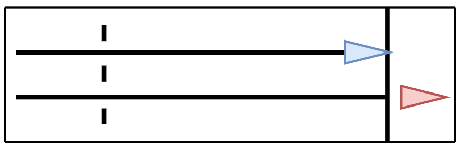
Figure 1. A robot stopping on the finish line - 3.2A round takes place between 2 robots, which are started simultaneously.
- 3.3A point is earned by the robot that is the first to stop within the stopping zone.
- 3.4The winner is the robot that is the first to earn 2 points during the match.
- 3.5The competition organizer determines the competition format (round-robin or double elimination system) and the maximum number of rounds.
- 3.6The technical inspection of the robots takes place when the 1st match is played during the competition.
It does not take place separately. - 3.7If the referee suspects an incorrect start, they have the right to start the robots themselves.
- 3.8If no robot achieves a counted result within the match, no winner is declared, and both robots are disqualified from further competition.
4Robot
- 4.1The robot's maximum size (width, length, height) and weight:
- LEGO®: 30x60x30 cm; 3 kg.
- Free construction: 30x60x30 cm; 3 kg.
- 4.2The robot must be fully autonomous.
- 4.3The robot must be equipped with a push-button start or a remote control, which can simply be started by the referee if necessary.
- 4.4The robot must have a 5-second delayed start timer.
- 4.5The robot must be capable of following the line under different lighting conditions. Complaints will not be considered.
- 4.6The robot's construction is prohibited from using sticky or oily substances or materials that leave stains.
- 4.7The robot must not cause any damage to the arena.
- 4.8NB! The LEGO® robot construction may consist only of parts available in LEGO® kits.
5Arena or track
- 5.1The track consists of a starting point, a straight line, a finish line and a stopping zone.
- 5.2The track size is 10 x 1 metres.
- 5.3The track line is at least 20 cm away from the edge of the base.
- 5.4The width of the black line is 15 mm, and of the finish line 30 mm.
- 5.5There is a defined starting position and a finish line on the track.
- 5.6The stopping zone is 60 cm long from the finish line.
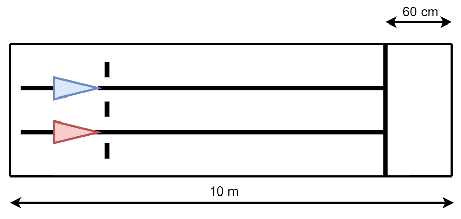
Figure 2. The track and the stopping zone
6Competition procedure
- 6.1When it is the participants' turn, the participants show the referee their robot's number.
- 6.2After the referee's permission, the participants place the robot at the starting position.
A part of the robot must be on the same level as the starting position. - 6.3The participant is given 1 minute to prepare their robot for the start and, if necessary, to hand over the robot's launch remote control to the referee.
If the start is not initiated, the attempt is recorded as DNF [Did Not Finish]. - 6.4After the start signal, the participants or the referee start the robots, which begin their run after 5 seconds.
- 6.5No more than 1 minute is given to complete the track.
If the robot does not complete the track within this time, it must be removed from the track. - 6.6If the robot loses the line, it can return to any point previously covered on the track. Otherwise, the attempt is recorded as DNF.
- 6.7If the robot loses the line for more than 5 seconds, the attempt is recorded as DNF.
- 6.8The robot's performance must not be influenced during the attempt.
- 6.9A participant is prohibited from stepping on the competition track.
- 6.10After the attempt, the participant may leave the discipline area only after the referee's signal.